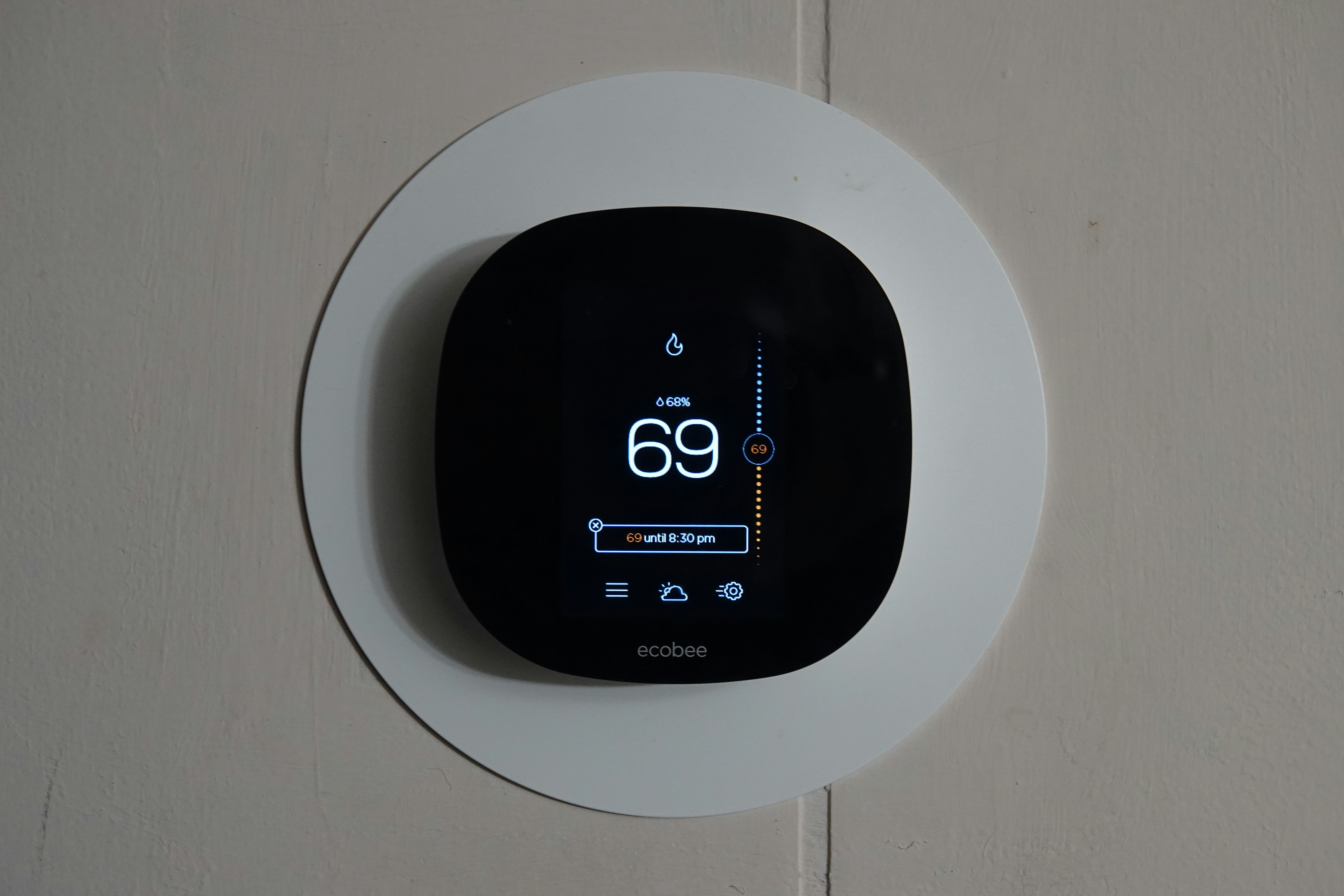
To compare thermostat options in Indianapolis, use the supplied 2026 utility rates as local cost assumptions: AES Indiana electricity at 17.41 cents per kilowatt-hour and Citizens Energy natural gas at $0.95 per therm. These rates provide context for the energy households use to heat their homes, but they do not determine a household’s heating expense on their own. Actual costs depend on consumption, billing details, and the equipment serving the home.
A $200 monthly heating bill is a useful illustrative baseline for estimating potential savings, not a claim about the typical Indianapolis household. Heating costs vary with home size, insulation, air leakage, furnace efficiency, and the temperatures occupants choose. The mix of gas and electricity used by a particular heating system also matters. Some households may spend substantially less or more than $200 in a winter month.
Applying a possible 10% reduction to that $200 baseline gives $20 in savings for one month: $200 multiplied by 0.10. A 15% reduction gives $30: $200 multiplied by 0.15. Thus, under this example, the estimated monthly savings range is $20 to $30. The percentage is an assumption for comparison, not a promised result from installing a smart or programmable thermostat.
If the same monthly baseline and savings rate are assumed for a six-month heating season, the arithmetic is straightforward. Six months at $20 saved per month equals $120, while six months at $30 saved per month equals $180. The resulting seasonal estimate is therefore $120–$180. It assumes each of those six months has a $200 heating bill, which may not reflect actual bills that rise and fall with outdoor temperatures.
These figures are scenario calculations, not a guaranteed reduction or a forecast of a specific home’s utility bill. Savings depend on weather, the household’s starting temperature schedule, and whether occupants consistently adjust settings when away or asleep. A thermostat has less opportunity to reduce use when temperatures are already kept low, while large setbacks may not suit every home or heating system. Comparing actual bills and usage over similar weather periods offers a more practical way to judge results.
Smart and programmable thermostats can both reduce heating costs, but they differ in price, capabilities, and the effort required to use them well. A smart thermostat typically costs about $130–$280. Depending on the model, it may offer remote control through an app, learning features, occupancy-based adjustments, and flexible scheduling. These functions can help households avoid heating an empty home and adjust settings without returning to the thermostat. The estimated savings range of 10–15% assumes that owners use relevant features effectively; it is not a guaranteed result for every household.
A basic programmable thermostat generally costs less, at approximately $35–$75. It allows residents to set temperature changes for recurring times, such as lowering the heat overnight or while the household is away. Using the article’s baseline of $200 per month for six winter months, a 5–8% reduction would amount to about $60–$96 over the season. That estimate depends on consistent scheduling, household routines, weather, energy prices, and other factors, so actual savings may be lower or higher.
For households with predictable routines and someone willing to set and maintain a schedule, a programmable model may offer stronger value because its purchase price is modest and its core function is straightforward. However, a schedule that is not updated when plans change may be less effective. Smart features can make adjustments more convenient, particularly for people with variable work hours, frequent travel, or changing occupancy. They may also make it easier to monitor and revise settings remotely. The higher initial cost is therefore best weighed against both potential energy savings and the value of convenience. Neither category guarantees a particular bill reduction: results depend on how the thermostat is used and the home’s heating needs.
A basic thermostat payback calculation divides the purchase price by the savings attributable to the device over a defined period. The result is meaningful only when the savings period is clear: a monthly estimate during winter should not automatically be treated as a saving that continues throughout the year.
Smart thermostats commonly cost about $130–$280. If a household saves an estimated $20–$30 on each heating-bill month, simple division produces a wide range of possible payback times, depending on the model’s price and the savings actually achieved. Headline estimates of roughly 8–18 months can serve as broad planning figures, but they are not guaranteed by the purchase and savings ranges alone. A household that saves only during a limited heating season may take longer to recover the cost in calendar months than one that also saves during cooling season.
Programmable models typically cost less, around $35–$75. On a $200 heating bill, a 5–8% reduction represents approximately $10–$16 in savings for each applicable month. The corresponding headline payback estimate is about 4–12 months. As with smart models, that range is approximate: the chosen device price, the household’s actual bill reduction, and the number of months in which savings occur all affect the result. Seasonal totals alone do not establish an exact calendar-month payback.
For a household comparing options, a lower-cost programmable thermostat may recover its purchase price sooner, particularly when its schedule settings consistently reduce heating use. A smart thermostat may still be worthwhile if remote control, automation, or more convenient adjustments matter to the household, or if it produces additional savings during the cooling season. To make a practical estimate, use your own energy bills, the price of the specific thermostat, and a realistic monthly savings figure. Multiply that monthly figure by only the months when savings are expected, rather than assuming it applies year-round. Treat the stated ranges as a starting point, not a universal promise.
For many compatible homes, replacing a thermostat is a roughly 30-minute DIY project. The actual time can vary with the existing wiring, HVAC equipment, and thermostat model, so treat that estimate as a guide rather than a guarantee. Before buying, check the thermostat manufacturer’s compatibility information and confirm whether your system requires a C-wire. If you cannot identify your equipment or establish compatibility, pause and contact an HVAC professional.
Follow the thermostat and HVAC manufacturers’ instructions throughout installation. At a high level, switch off HVAC power at the breaker, then photograph the existing wiring and label each wire before disconnecting it. Mount the new thermostat’s base, connect each wire to the corresponding terminal specified in the product instructions, and secure the thermostat. Restore power only after checking the connections. Then test heating and cooling, where applicable, and confirm that schedules and temperature settings work as intended. Stop if the wiring does not match the instructions or anything appears damaged or unfamiliar.
A phone-based C-wire checker may be available at no cost, depending on the service and device. A flathead screwdriver and voltage tester may also be needed; together, these tools are estimated to cost about $12–$22. Do not assume that every installation is suitable for a homeowner: some systems need additional wiring, specialized handling, or professional assessment.
For Indianapolis homes in climate zone 5a, use a practical checklist when comparing models. Verify compatibility with both the furnace and cooling system, and confirm that the thermostat supports the wiring already in the home. Compare scheduling options and remote-control features, considering how each may suit household routines and winter temperature management. Review the American Choice installation guide and model comparison for product-specific details before purchasing. Seek help from an electrician or HVAC technician if you encounter unfamiliar wiring, a line-voltage system, or an unusual HVAC configuration. A careful compatibility check can help prevent a purchase that cannot be safely installed or used as intended.
If you’re interested in purchasing the item you seek, please click the link for additional details: #americanachoice.
https://amzn.to/3SBN3Oy
AFFILIATE DISCLOSURE: I am an affiliate for this company, I am not a paid employee.
I may receive a commission if you click a link on this page and choose to purchase something.
You can rest assured I will only share things I believe in and will be valuable to you.